




If you've asked around about fertigation in India, chances are someone has already pointed you toward a venturi injector. It's cheap (anywhere from ₹100 to ₹500 for a basic unit), it has no moving parts, and it doesn't need electricity. For a lot of small and mid-sized farms, it's the first piece of fertigation equipment they ever buy. It's also, in most cases, only half the story.
How a venturi actually works
A venturi is a short section of pipe with a narrowed throat in the middle. As irrigation water is forced through this throat, its velocity increases and its pressure drops (this is simple fluid dynamics, the same principle that lets an aircraft wing generate lift). That pressure drop creates a vacuum at the throat, and this vacuum is strong enough to pull liquid up through a suction line connected to a fertilizer tank.
In practical terms:
- Water enters the venturi at, say, 3 bar
- It exits at a lower pressure, often 1 to 1.5 bar lower, because of the differential the venturi is designed to create
- That differential pressure is what does the work. No pump, no electricity. Just physics.
- The fertilizer solution is drawn into the mainline and mixes with the irrigation water as it flows toward the field
Most venturi injectors are installed as a bypass off the main irrigation line. Some setups add a rotameter (a simple flow-indicator with a floating ball in a tapered tube) on the suction line, which gives you a rough visual read of how fast fertilizer is being drawn in.
That's it. That's the entire mechanism. It's elegant, and it's why the venturi has been the default entry point into fertigation for decades, from Israeli drip pioneers to your local input dealer in Nashik or Coimbatore.
Where most farmers stop and where the real problem starts
Here's what usually happens on the ground. A farmer buys a 1-inch or 2-inch venturi, plumbs it into the mainline exactly as the dealer showed, opens the suction valve, and watches fertilizer disappear into the tank. Something is clearly happening. But three questions rarely get answered before that valve is opened:
1. What is my actual flow rate through the venturi?
Every venturi has a performance curve. Its suction rate isn't a fixed number, it depends entirely on the pressure differential across it, which in turn depends on your mainline flow rate at that moment. If your pump is running at a different output than what the venturi was rated for, or if a zone valve upstream is partially closed, the suction rate shifts, sometimes drastically, without any visible sign at the injector itself.
2. What is the concentration of my fertilizer solution?
A venturi doesn't know or care what's in the tank. If your Tank A stock solution is at 1:100 dilution one week and 1:80 the next (a common outcome when solutions are mixed by eye or by a labourer's estimate), the venturi will draw the same volume of liquid regardless. The nutrient load reaching the root zone changes even though nothing at the injector changed.
3. What EC and dosing rate does my crop actually need at this growth stage?
This is the piece that gets skipped most often. A capsicum crop at vegetative stage and the same crop at fruit-fill need different EC targets and different N:K ratios. A venturi has no way to distinguish between the two. It pulls at whatever rate the pressure differential dictates, on whatever solution happens to be in the tank, regardless of whether your crop needs an EC of 1.8 mS/cm or 2.6 mS/cm that week.
Put together, this means a venturi answers the question "how do I get fertilizer into my line without a pump" reasonably well. It does not answer "how much fertilizer is my crop receiving right now," which is the question that actually determines yield and quality.
Why this gap matters more as farms scale or specialize
On a small non-commercial farm, this imprecision is forgiving. Crops tolerate a wide EC band, and the consequences of a slightly off dose are minor. But the moment you're running a soilless capsicum poly-house, a multi-variety blueberry block, or a commercial raspberry farm where fruit grade and shelf life depend on tight nutrient control, the venturi's blind spots turn into real cost.
Two farms with an identical venturi setup, fed from identical stock tanks, can deliver meaningfully different nutrient loads simply because their mainline pressure and flow varied that day. Over a season, this shows up as inconsistent fruit size, uneven flowering, or nutrient deficiencies that seem to appear for no clear reason, because the reason was never visible in the first place. Nobody was measuring flow rate, concentration, and target dose as three linked variables. Each was left to chance, or to a labourer's habit.
This isn't a flaw in the venturi. It's doing exactly what it was designed to do: create suction from a pressure differential. The flaw is in expecting a passive hydraulic device to also perform the job of a dosing calculation, three separate jobs that a venturi was never built to handle.
What actually closes the gap
Solving this doesn't necessarily mean throwing out the venturi. It means adding the layer that was missing: a system that continuously reads your actual flow rate, knows your target EC and NPK ratio for the current crop stage, and adjusts dosing in real time to hit that target, regardless of what the mainline pressure happens to be doing at that moment.
This is precisely the gap Nutripulse was built to close. Instead of relying on a fixed pressure differential to pull an unknown volume of an unknown-strength solution, Nutripulse monitors flow and EC continuously and doses proportionally, so the same recipe delivers the same nutrient load whether your system is running at 2.8 bar or 3.4 bar. For farms running multiple crop varieties or multiple pH-sensitive recipes (as we've seen on fertigation setups across Nashik, Bangalore, Nelamangala, and Shimoga), that consistency is the difference between a crop that performs on paper and one that performs in the field.
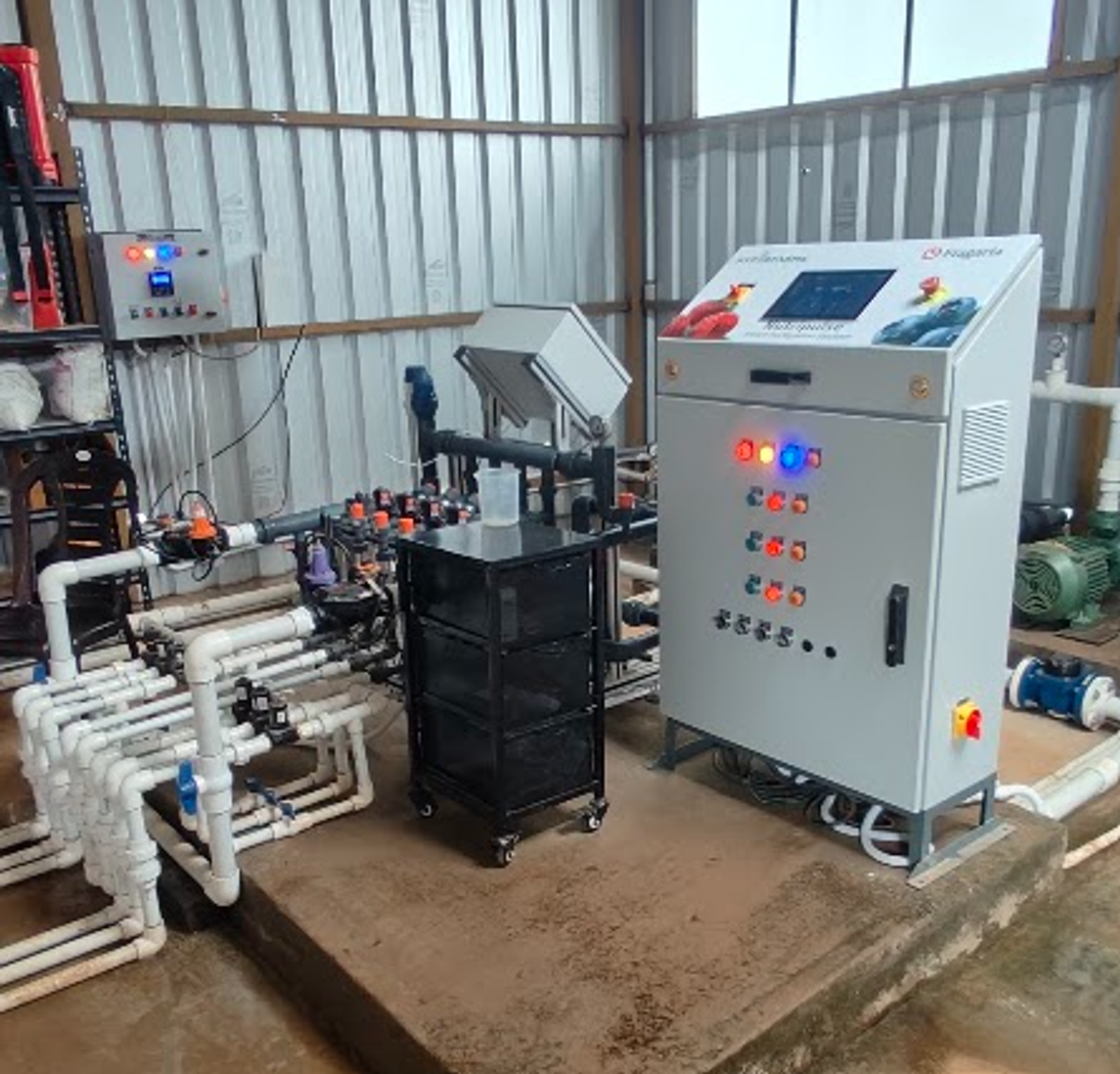
A venturi answers how fertilizer gets into the line. Flow rate, concentration, and dosing targets answer how much of it actually reaches the crop, and that second question is the one worth solving properly